
Jerónimos Monastery
The magic of Jerónimos is in its details. This guide helps you notice the craftsmanship, symbolism, and stories that make the monastery more than just a beautiful landmark.
Read this before you enter
Avoid the most common visitor mistakes.
Visitor essentials
Entry timing, transport, rules, and facilities for Jerónimos Monastery.
Slot arrival
Join the security line 15 minutes before your timed entry slot.
Public transport
Take tram 15E to Mosteiro Jerónimos; the entrance is opposite Praça do Império.
Security check
Expect a bag check at the main portal on Praça do Império.
Bags
Large suitcases are turned away at the entrance security screening.
Photography
Flash and tripods are not allowed inside the church and cloister areas.
Accessibility
Step-free access is via the cloister ramp; some interior thresholds remain uneven.
Explore Smarter
Insider shortcuts, better routes, and smart decisions that save time inside.
Start with the Cloister loop
Head straight to the Claustro; the corner columns choke up after 11:00. Do a full clockwise lap before stopping for photos.
Find Vasco da Gama’s tomb
In the Church (Igreja de Santa Maria), go to the right transept for Vasco da Gama’s tomb; most people drift past to the nave.
Climb to the upper choir
Take the stairs to the coro-alto for a straight view down the church nave. The railings keep phones steady for clean shots.
Skip the small side chapels
If you have 45 minutes or less, pass the side chapels and stay on the cloister plus church main axis.
Use the cloister as your reset
Finish in the cloister garden for a 5-minute quiet break, then re-enter the galleries; it beats fighting the church exit pinch-point.
Start with the Cloister loop
Head straight to the Claustro; the corner columns choke up after 11:00. Do a full clockwise lap before stopping for photos.
Find Vasco da Gama’s tomb
In the Church (Igreja de Santa Maria), go to the right transept for Vasco da Gama’s tomb; most people drift past to the nave.
Climb to the upper choir
Take the stairs to the coro-alto for a straight view down the church nave. The railings keep phones steady for clean shots.
Skip the small side chapels
If you have 45 minutes or less, pass the side chapels and stay on the cloister plus church main axis.
Use the cloister as your reset
Finish in the cloister garden for a 5-minute quiet break, then re-enter the galleries; it beats fighting the church exit pinch-point.
Inside Jerónimos, step by step
Walk the standard route and spend time only where the stonework and tombs repay a slow look.

South Portal of Jerónimos Monastery
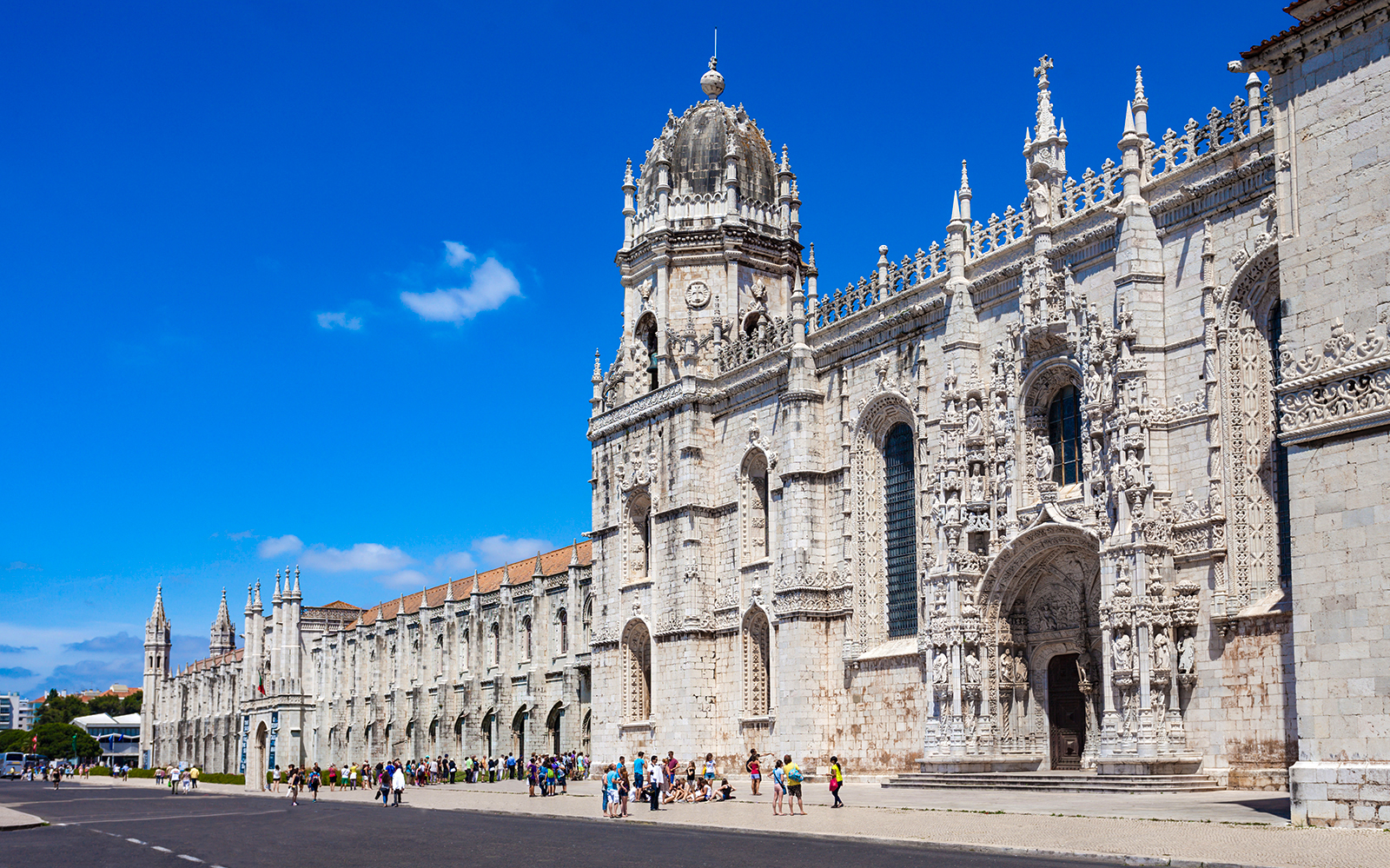
Start at the south façade and read the carving like a stone altarpiece before going inside. The portal stacks saints, kings, and sea imagery in tight Manueline relief.
What to notice here
- Virgin and Child (South Portal)
Look for the Virgin’s niche at eye-line above the doorway.
- Henry the Navigator statue
Spot Infante D. Henrique on the left side of the portal.
- King Manuel I statue
Find D. Manuel I on the right, linked to the monastery’s funding.
⚡ Quick story
The south portal is a public manifesto of Manueline style, tied to the early 1500s maritime empire and royal patronage.
📍 Visitor tip
Stand 6 metres back on the forecourt to read the full vertical composition in one glance.
Pick your route
Grab the highlights fast, follow Manueline details deeper, or go slow for tombs, cloisters, and quiet corners.
The greatest hits in under two hours
Hit the headline spaces in walking order, with minimal backtracking and no deep-reading stops.
Church of Santa Maria · South Portal · Cloister · Chapter House
Read the stone like a script
Trade speed for details, focusing on Manueline carvings, columns, and sightlines across two levels.
Cloister · Chapter House · Refectory · Church choir
Slow loop for tombs and silence
Add museum rooms and upper cloisters for context, trading time for fewer repeat views.
Archaeology Museum · Refectory · Cloister · Church of Santa Maria

Hidden details most people walk past
Five on-site details inside Jerónimos Monastery that reward slow looking in the cloister and church.
Spot these as you loop the cloister and step into the church.
Cloister vaults with Manueline bosses
Lower cloister, corner bays by the Chapter House door
Look for: Tilt your head to the ribbed stone ceilings and pick out carved rope twists, armillary spheres, and tiny leafy bosses at the rib junctions.
Why it matters: These vault carvings are prime Manueline stonework tied to King Manuel I’s reign (1495–1521) and Portugal’s Age of Discoveries symbolism.
Armillary spheres in the arcade spandrels
Lower cloister, inner arcade, between the arches facing the courtyard
Look for: Scan the triangular spandrels above the columns for repeated armillary-sphere emblems and cross motifs carved into the pale limestone.
Why it matters: The armillary sphere is King Manuel I’s personal device, and its repetition turns the cloister into a political signature in stone.
Chapter House starry rib vault
Chapter House, off the lower cloister on the west side
Look for: Step under the single-span ceiling and trace the ribs as they fan into a star pattern before meeting the walls with no central support column.
Why it matters: The engineering flex of this late-Gothic vault showcases the monastery’s 16th-century ambition under architect João de Castilho.
Vasco da Gama tomb details
Church of Santa Maria, chancel area, right side near the main altar
Look for: Move close to the sculpted tomb chest and read the nautical carvings and heraldic shields worked into the stone around the effigy.
Why it matters: Vasco da Gama (d. 1524) is fused here with royal propaganda, linking ocean routes to the monastery funded by imperial trade.
Luís de Camões tomb carvings
Church of Santa Maria, chancel area, left side near the main altar
Look for: Check the tomb’s carved emblems and figurework around the recumbent form, then compare its styling to the opposite tomb across the chancel.
Why it matters: Luís de Camões (c. 1524–1580) anchors Portuguese literary identity inside a royal monastic setting built at the height of maritime power.
Planning a lower-effort monastery visit
Know what to skip, where to pause, and how to reduce standing inside.
Accessibility & easier access
Reduce stairs and standing by choosing a shorter loop and fixed stops.
- Prioritise the Cloister and church, then skip the museum rooms if fatigue starts.
- Use the venue’s accessibility entrance where available; ask staff on arrival to confirm.
- Plan a seated pause in the church nave before the cloister, where benches are usually available.
With young kids
Keep it simple: one big highlight, one calm space, then exit.
- Do the Cloister first, then use the church as a quieter reset before leaving.
- Choose a baby carrier over a stroller on the cloister’s stone thresholds and tight corners.
- If queues look long at the main door, ask staff for the family-friendly entry option.
Where to get the best shots
Five angles inside Jerónimos that dodge crowds and nail Lisbon light.
 ICONIC VIEW
South portal main steps
Shoot the Manueline arch head-on at 09:30 for clean stone and minimal people.
 RIVER BACKDROP
Cloister south arcade
Frame pointed arches with Tagus light through openings at 11:00 for bright, graphic silhouettes.
 DRAMATIC SHOT
Two-level cloister corner
From the upper gallery at 10:00, capture stacked arches and repeating shadows down the courtyard.
 GOLDEN HOUR
Church nave center aisle
Aim east at 17:30 for warm shafts on columns and a straight, symmetrical aisle frame.
 HIDDEN ANGLE
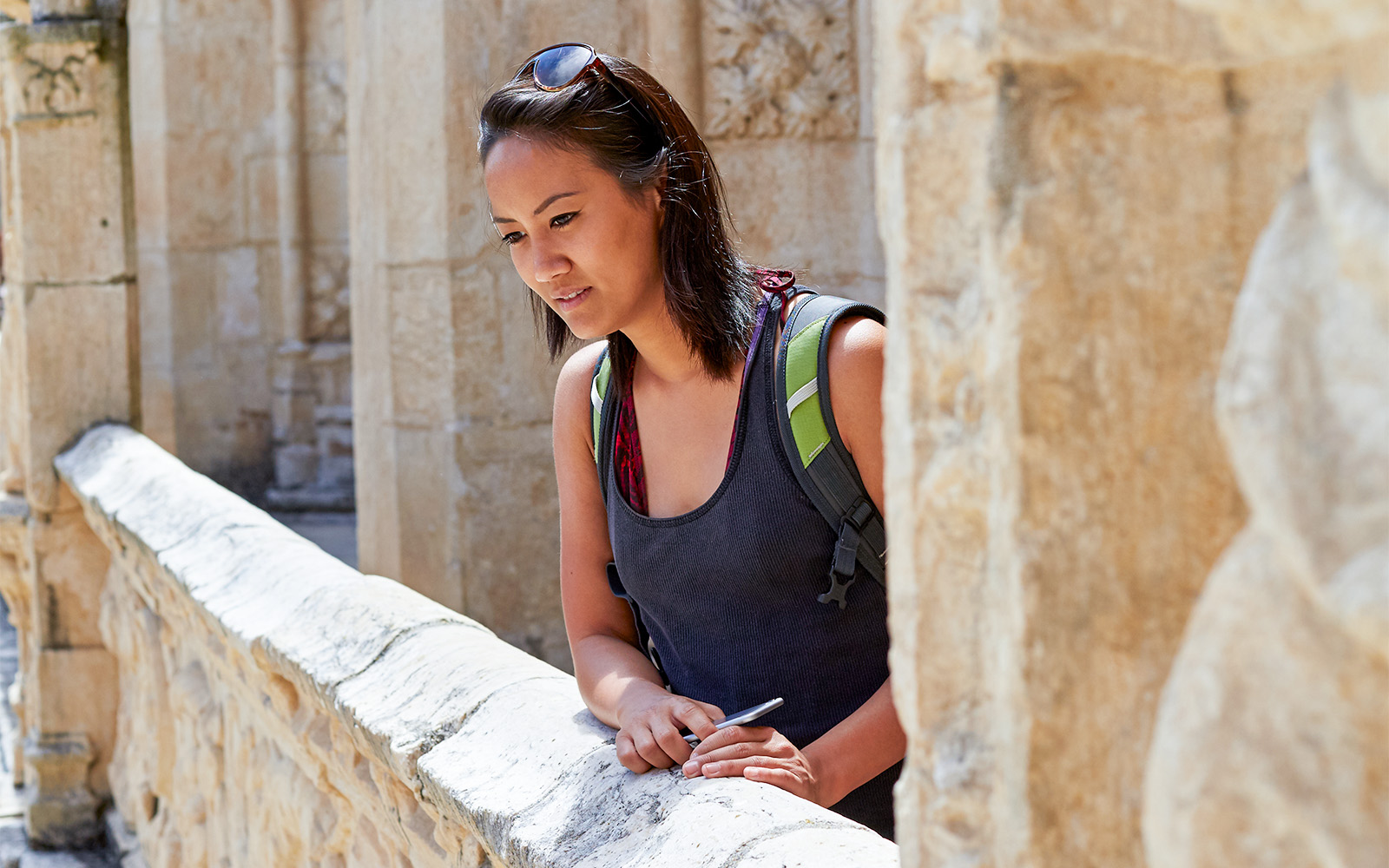
Cloister spiral staircase exit
Stand one step below the landing at 10:30 for a tight arch-frame that hides crowds.
After the cloisters
Keep Belém simple: riverside walk first, then pick food, shade, or one more landmark within 15 minutes.

Belém riverfront walk, Padrão dos Descobrimentos to Torre de Belém
Exit Jerónimos to Praça do Império, cross to the Tagus path, then walk past Padrão dos Descobrimentos toward Torre de Belém for wide views and easy photos.
Go near 18:30 for softer light; the riverside path stays flat.

À Margem
Take a table on the Tagus at Doca do Bom Sucesso for seafood, salads, and a proper break; mains run roughly €18–€30.

Jardim da Praça do Império
Sit under the palms in the formal gardens facing Jerónimos, with fountains, long benches, and steady shade 2 minutes from the monastery doors.

MAAT rooftop terrace
Walk 12 minutes to MAAT and climb the curved roof for a clean Tagus panorama; museum entry is usually €9, and sunset slots get busy.
